


To help beekeepers make appropriate management decisions during winter and early spring, 17 land-grant universities, one statewide cooperative extension system, five USDA ARS labs (Baton Rouge, Beltsville, Poplarville, Stoneville, Tucson), and three beekeepers are jointly monitoring athe mount of capped brood in their colonies throughout the country from mid-October to the end of February.
This page will be updated approximately every 2 weeks so that the amount of capped brood in the monitored colonies can be communicated to the beekeeping community.
Access dynamic map Citizen Science Winter Capped Brood Monitoring Contact
Biweekly Static Maps
Week of February 25, 2026

Week of February 11, 2026

Week of January 27, 2026

Week of January 13, 2026

Week of December 31, 2026

Week of December 17, 2025

Week of December 3, 2025
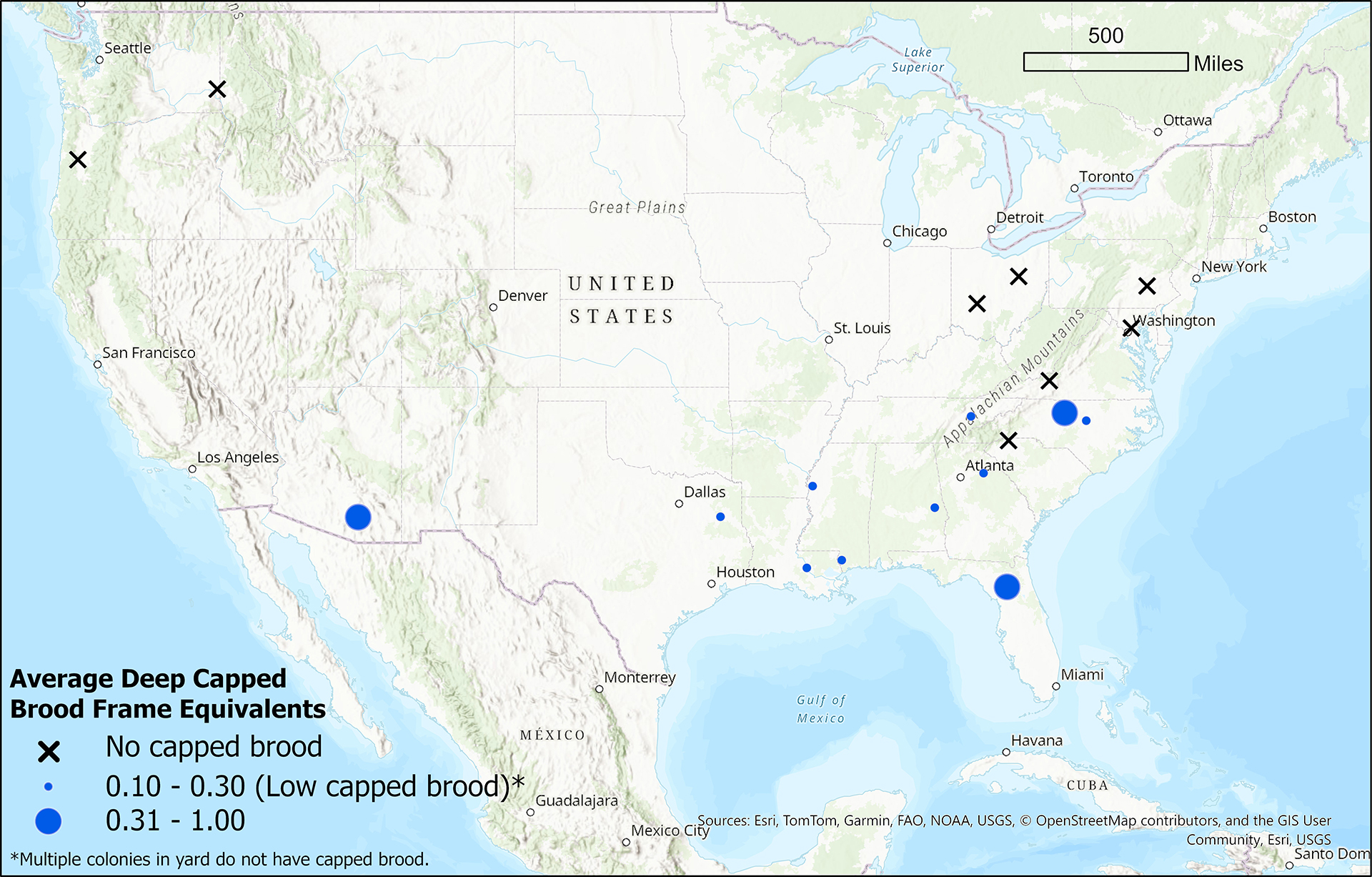
Week of November 19, 2025
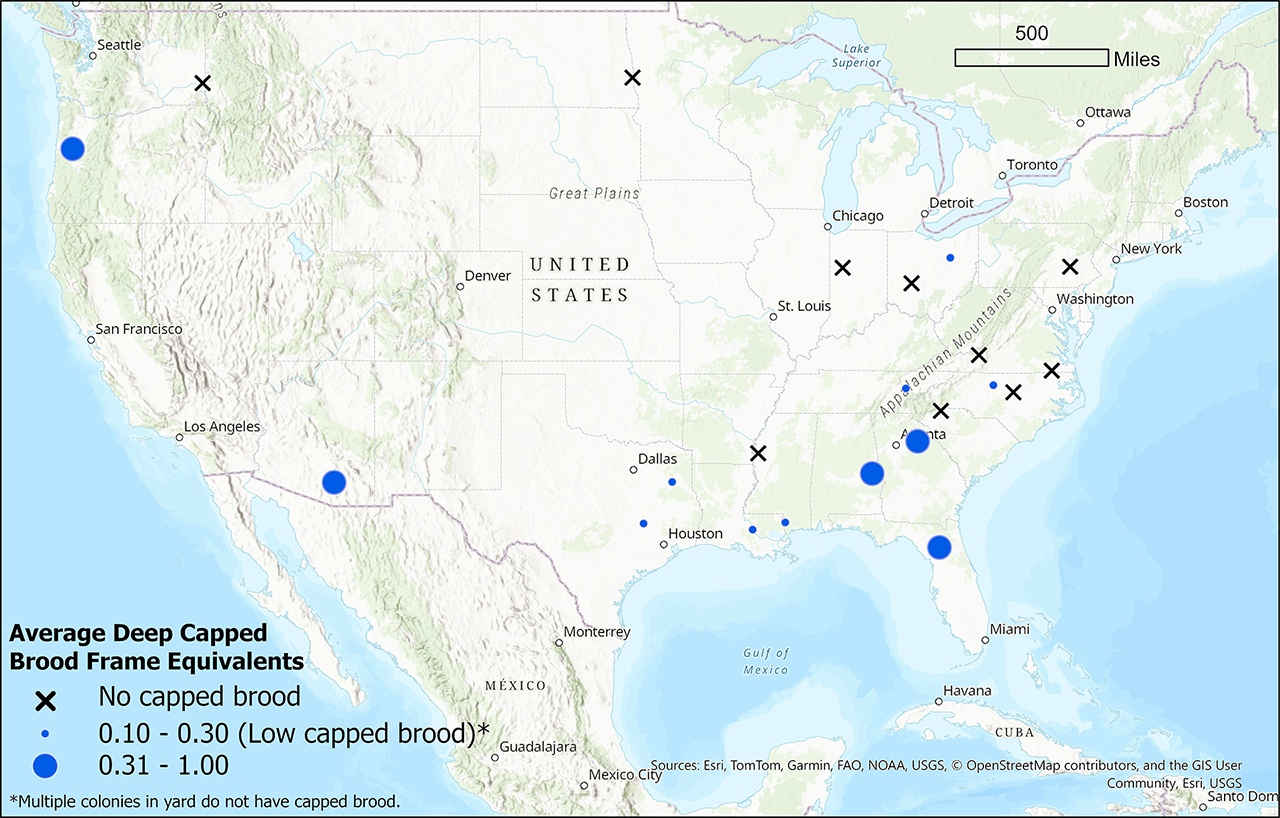
Week of November 5, 2025
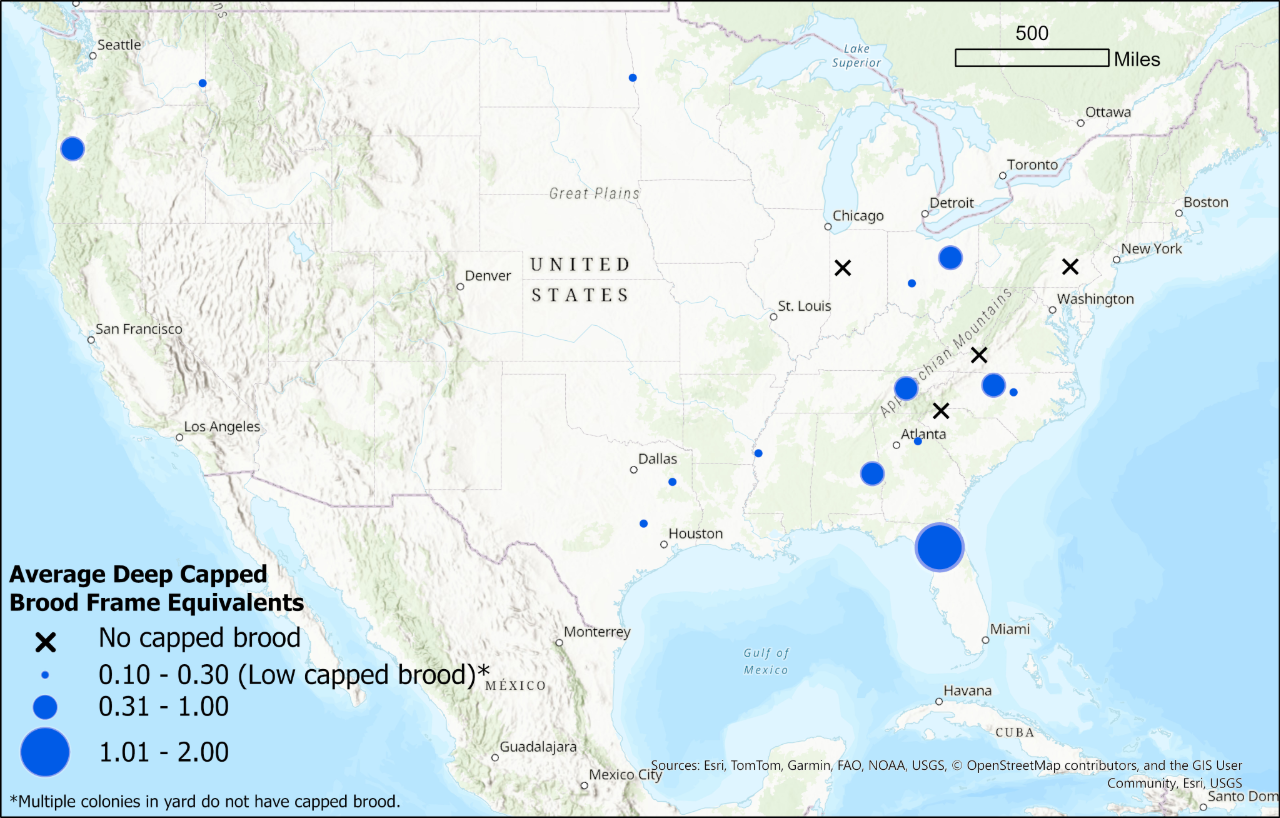
Week of October 22, 2025
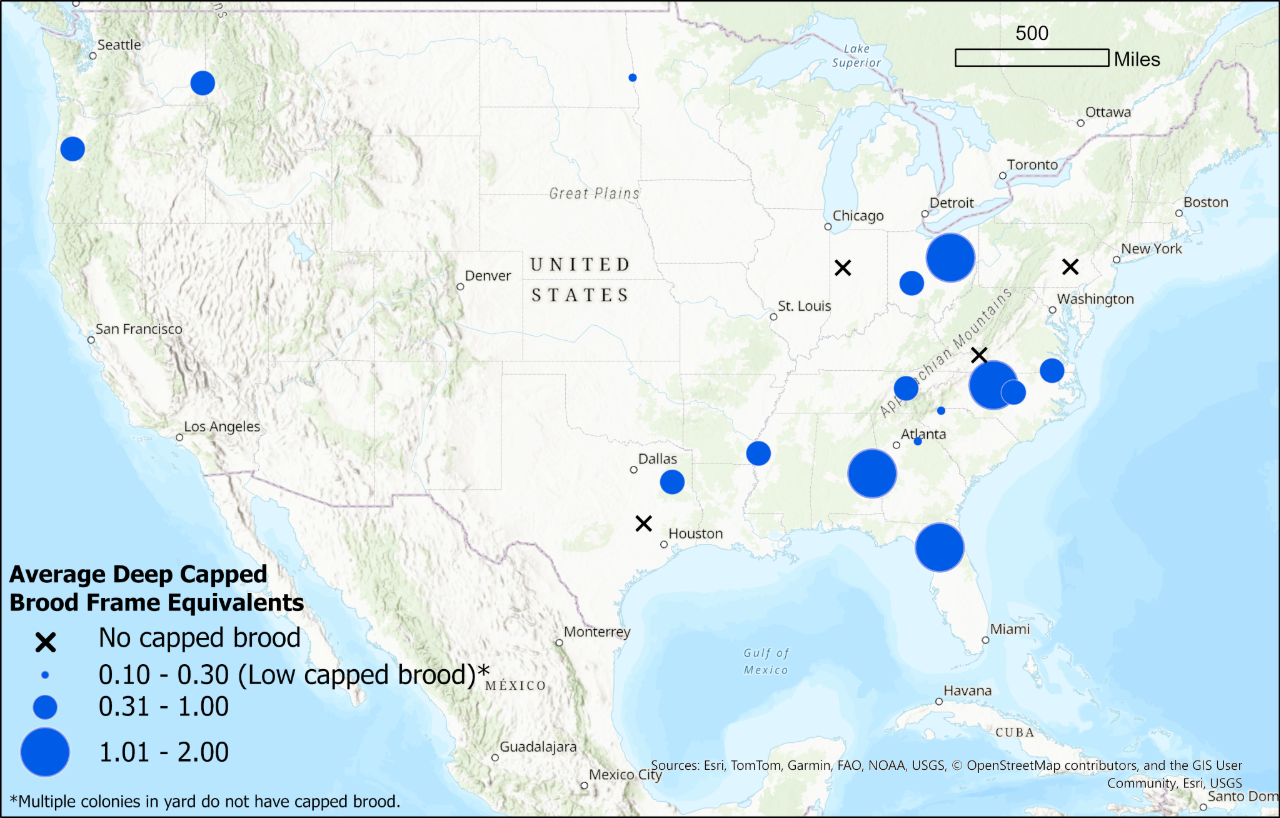
Week of February 27, 2025

Week of February 13, 2025

Week of January 30, 2025

Week of January 16, 2025

Week of January 2, 2025

Week of December 19, 2024

Week of December 5, 2024

Week of November 21, 2024

Week of November 7, 2024
 Week of October 24, 2024

Week of March 6, 2024

Week of February 21, 2024

Week of Feb. 7, 2024

Week of Jan. 24, 2024

Week of Jan. 10, 2024

Week of Dec. 27, 2023

Week of Dec. 13, 2023

Week of Nov. 30, 2023

Week of Nov. 16, 2023 
Week of Nov. 2, 2023

Week of Oct. 19, 2023

Week of Feb. 20, 2023

Week of Feb. 6, 2023

Week of Jan. 23, 2023

Week of Jan. 9, 2023

Week of Dec. 26, 2022

Week of Dec. 12, 2022 
Week of Nov. 28, 2022

Week of Nov. 14, 2022

Week of Oct. 31, 2022

Week of Oct. 17, 2022

Citizen Science Winter Capped Brood Monitoring Program

The US Winter Capped Brood Monitoring Project is underway for its fourth season. Every two weeks from October to February, Auburn University, along with other universities and USDA labs from across the country, inspects colonies for capped brood. This effort helps us understand the best times for winter oxalic acid mite treatments and which areas will be most at risk for another parasitic mite, Tropilaelaps, if it is introduced to the US.
Beekeepers: we need your help tracking capped brood across the US. This involves inspecting three hives (or fewer if necessary) for capped brood.
Inspections should happen during three windows in December and January, detailed below:
- Friday, December 19, 2025 to Sunday, December 21, 2025
- Friday, January 2, 2026 to Sunday, Janurary 4, 2026
- Friday, January 16, 2026 to Sunday, January 18, 2026
We ask that you please inspect your colonies during as many of these 3 event windows as possible. If you can only inspect colonies within one or two of these windows, we still want your observations!
Each colony inspection should take 2-3 minutes.
- Smoke the colony.
- Remove supers or hive bodies until you can locate the cluster. If it is very cold, you may cover bees in removed boxes with an extra inner or outer cover.
- Make note of colony strength. We consider clusters about the size of a basketball to be “normal” strength. Weak colonies have smaller clusters (softball-sized or smaller), while strong colonies are much larger than a basketball.
- Carefully remove 1-3 frames from the center of the cluster. If there is capped brood on any of the frames, report “Yes” on the survey. If you find uncapped brood (eggs or larvae without wax cappings) and no capped brood, report “No” on the survey. Fewer than a dozen total capped brood cells that are chilled, dead, or not guarded by the bee cluster count as no brood.
For more information, refer to our video below:
 Cells containing capped brood, or brood in the pupal stage, will have a slightly domed or convex wax capping. They have a rough, porous texture. This picture shows several dozen capped brood cells. If the inspected frame(s) looked like this, we would say yes, this colony has capped brood.
 A colony may have eggs or larvae without wax cappings, but no capped brood. This picture shows both younger and older larvae. If the brood on all inspected frames looked like this, we’d say no, this colony does not have capped brood.
 Capped honey is sometimes mistaken for capped brood. Compared to brood, the wax cappings on honey cells are smoother. The comb surface may have a rippled texture. This photo does not show any brood.
 Often, bees in winter will form a tight cluster as they consume stored honey. Small patches of brood may still be present beneath the bees. In this case, we may need to move some bees aside to view the brood.
Collaborators
- Alabama Extension Beekeeping Team
- Auburn University Bee Center
- Auburn University GeoIDEA Lab
- Central State University
- Cornell University
- Enterprise State Community College
- University of Florida
- University of Georgia
- Mississippi State University (Amiri)
- North Carolina State University
- Oregon State University
- Penn State University
- University of Tennessee
- Texas A&M University (Rangel)
- Texas A&M University (Slater)
- Ohio State University
- University of North Carolina Greensboro
- North Dakota State University
- Purdue University
- Virginia Tech University
- Washington State Universtiy
- USDA ARS Baton Rouge
- USDA ARS Beltsville
- USDA ARS Poplarville
- USDA ARS Stoneville
- USDA ARS Tucson
- Beekeeper Bill Elliott
- Beekeeper Kristine Smith
- Beekeeper Mark Sweatman
This work is being supported through funding from the Southern IPM Center 2022-70006-38002, the USDA ARS Cooperative Agreement 58-6066-3-029, the USDA National Institute of Food and Agriculture 2023-51181-41246, and the USDA National Food Institute of Food and Agriculture Hatch Multi-state Project NC1173.
Auburn University Bee Center
334-844-5068
Ben DeMoras
Ph.D. Student
952 Bee Lab Road
Auburn, AL 36849
